Rosatom presented process solutions to expand strategic cooperation between Russia and India at “Innoprom.India” international industrial exhibition
16.09.2026
The state-owned corporation showcased solutions in nuclear energy, additive manufacturing, composite materials, and metallurgy. Digitalization and Logistics
Rosatom participated in the “Innoprom. India” International Industrial Exhibition, held in Delhi from September 9 to 11, 2026. During an official tour of the exhibition, Russian Minister of Industry and Trade Anton Alikhanov and Indian Minister of Commerce and Industry Piyush Goyal reviewed the key achievements of the long-standing cooperation between Russia and India in the field of nuclear and related technologies, which were presented by the First Deputy Director General – Director of the Development and International Business Division at Rosatom State Corporation, Kirill Komarov.
The ministers were shown the most advanced and efficient type of Russian reactor—VVER-1200—using the Novovoronezh Nuclear Power Plant as an example; a model of the plant was displayed at the state corporation’s booth. In the “Process Sovereignty Products” zone, Kirill Komarov discussed prospects for expanding cooperation in the fields of additive manufacturing, composite materials, and digital and logistics solutions.
“India is steadily expanding its nuclear power sector and has set an ambitious goal of increasing its nuclear capacity to 100 GW by 2047.” Rosatom is already making a practical contribution to achieving this goal: we are the only foreign company building a nuclear power plant in India. Two power units at the Kudankulam PPP are operating steadily, while four more are at various stages of construction. Considering the scale of the challenge India has set for itself, we are ready to offer our partners a wide range of modern nuclear solutions—from high-capacity power units to small modular reactors. Our partnership extends far beyond nuclear energy to include nuclear medicine, additive manufacturing, composite materials, and logistics. I am sure that Russian technologies will help strengthen India’s process sovereignty”, said Kirill Komarov.
Kirill Komarov also took part in the forum’s business program, speaking at the main plenary session, “Strengthening the Russian-Indian Trade and Industrial Partnership—Toward Self-Sufficient Cooperation,” and at a joint session with the Confederation of Indian Industry titled “India–Russia: Business Cooperation, Strategic Partnerships, and New Opportunities”.
The Minister of Commerce and Industry of India, Piyush Goyal, emphasized during the Russia-India Business Dialogue the need to move from agreements to practical industrial cooperation and called on Russian companies to expand their manufacturing operations in India by leveraging the country’s industrial potential, skilled workforce, and the opportunities offered by the “Make in India” initiative.
For reference:
Representatives of the industry integrator specializing in “Additive Technologies”took part in the session titled “Additive Manufacturing: A New Direction for the Development of the Russian-Indian Partnership,” during which they discussed the possibility of moving toward the joint creation of an entire ecosystem for the additive technologies industry. They explained how additive technologies reduce the cost of equipment for end users by 40% and discussed real-world case studies on equipment localization, as well as the initial results of similar projects at their Indian partner’s production site. They shared their experience on how to jointly build the entire value chain: from the supply and creation of turnkey additive manufacturing centers to technology transfer and equipment localization.
Rosatom Metalltech LLC (a company within the Rosatom Metalltech Fuel Division) hosted a session titled “Critically Important Minerals and Materials: New Opportunities for Industrial Cooperation.” The participants in the discussion addressed issues related to industrial cooperation in the production of rare-earth magnets, the creation of a consolidated market for rare-earth products, as well as government support measures and efforts to attract investment for the development of new production capacity. In addition, during the roundtable discussion titled “Russia–India: Cooperation in the Steel Industry”, Rosatom metallurgists presented four product areas for cooperation with Indian partners: titanium, zirconium, hafnium, and calcium.
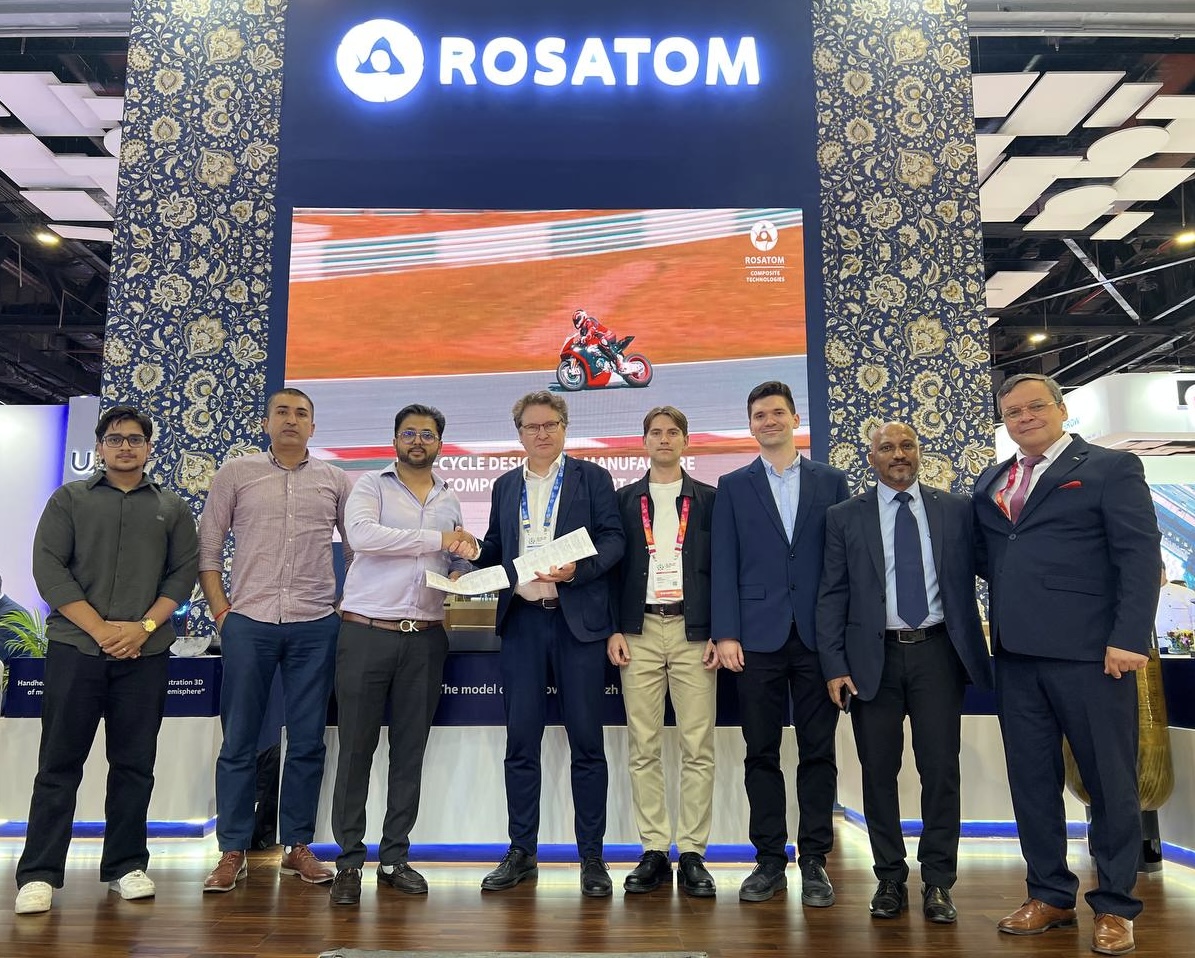
At the exhibition, Engineering and Technology Center GET (a subsidiary of Rosatom Service JSC, the Electric Power Division of Rosatom) signed a distribution agreement with the Indian company Syngient Technologies regarding the Repeat Vision software platform (a next-generation software platform for end-to-end design and simulation of complex industrial systems). A memorandum of understanding was also signed with the Indian company EM Services. The document provides for mutually beneficial cooperation in the energy sector, including in the areas of the digital transformation of power plants and the maintenance, reconstruction, and modernization of energy facilities.
At Rosatom State Corporation exhibition booth Engineering and Technology Center GET presented a practical case study to demonstrate REPEAT VISION, a next-generation software platform for end-to-end design and simulation of complex industrial systems. Developed specifically for the nuclear industry and related fields, REPEAT VISION is part of Rosatom portfolio of digital products. Visitors to the booth also had access to demonstration displays of digital twins of the power grid and the port.
“We offer a comprehensive approach to developing cooperation, which includes, in particular, the training of a highly qualified talent pool to meet the needs of India nuclear industry.” We see significant potential for collaboration in the development, implementation, and maintenance of educational services, including training programs and hands-on workshops that utilize educational analytical simulators for Indian professionals.
The development of cooperation in the field of creating digital twins also appears promising, as this technology enables the creation of virtual models of real-world objects, the simulation of their operating modes, the analysis of various operational scenarios, and data-driven decision-making. In practical terms, this means improving operational efficiency, optimizing repairs and maintenance, reducing equipment downtime, and increasing equipment reliability throughout its entire life cycle” noted Alexey Kovalevich, CEO of Engineering and Technology Center GET JSC.
The Giredmet Institute (the Chemical and Technological Cluster of the Scientific Division of the Rosatom State Corporation) and the Indian company Alt Metals Private Limited have signed a contract to carry out work on the creation of a pilot production facility for titanium sponge.
The Rosatom booth also featured, among other things, glass- and carbon-fiber-based solutions for compressed natural gas storage and transportation systems, a portable laser metrology solution, and an interactive energy simulator. Special attention was given to achievements in the field of industrial 3D printing and the localization of manufacturing. The first localized 3D scanner developed in Russia and manufactured at an Indian partner's facility was demonstrated at the booth. The localization of Russian 3D scanner production in India began this year, reducing the cost of the equipment for customers in the domestic market by 40% and enabling the products to qualify as “Make in India” goods.
“Innoprom.India” is a platform for fostering international cooperation in the field of industrial technologies, opening up new business opportunities in India, one of the world’s largest and fastest-growing economies.
One of the key projects of Russian-Indian cooperation in the nuclear sector in India is the construction of the Kudankulam NPP. The Kudankulam NPP project is being implemented under the Intergovernmental Agreement on Cooperation in the Construction of a Nuclear Power Plant in India, signed on November 20, 1988, and its addendum dated June 21, 1998. Power Units 1 and 2 of the Kudankulam NPP were connected to India national power network in 2013 and 2016. They are the most powerful nuclear power units in India. They have already generated more than 132 billion kWh of electricity during their operational life (as of April 2026). Power Units No. 3, No. 4, No. 5, and No. 6 constitute the second and third phases of the Kudankulam NPP, each equipped with VVER-1000 reactor. When all six power units are commissioned, Kudankulam NPP will meet a significant portion of the electricity needs of the state of Tamil Nadu, with a population of nearly 85 million people, as well as other states to which the generated electricity will be distributed.
There are currently six VVER-1200-based power units in operation worldwide: four in Russia and two in Belarus. The VVER-1200 units are under construction in Bangladesh, Hungary, Egypt, China, and Türkiye. Kazakhstan has also selected this type of unit. Russia is offering India the opportunity to continue cooperation in the nuclear sector by building a new nuclear power plant in the country using this type of reactor.
The Rosatom Fuel Division, which is developing the “Additive Technologies” business line, supplied RusBeam 2800 industrial 3D printing system to India in April 2026. The executed contract was signed upon winning an international tender; it is the first supply of a 3D printer manufactured by Rosatom to non-CIS states. The large parts printed on this printer will speed up the prototyping and production of components for the future “Gaganyan” spacecraft and the “Bhatiya Antariksh” and “Chandrayaan” space stations. The Indian customer’s decision to choose Rosatom technologies confirms the high level of competitiveness of Russian solutions in the global market and their compliance with the most stringent international standards.
Last news